
Today we bought an electric vehicle.
That sentence alone would have sounded futuristic twenty years ago. Now it is just another Saturday errand. The dealer told us demand is up, but only slightly. He reckons, and I agree, that next week the penny will drop for the normies that the fuel price shock is pointing to something that is not temporary. Then he’ll be flat out.
Petrol in March 2026 is about to become the toilet paper of March 2020.
While we were signing the paperwork, a television in the showroom was running Al Jazeera. The volume was low but the captions rolled steadily across the bottom of the screen. It was all about Iran blowing up oil infrastructure.
Until 1971, global currencies were tied, at least nominally, to something real. Gold, silver, other metals. Cowrie shells in ancient China. Physical anchors that restrained governments from simply conjuring wealth from paper, and now digital, promises.
When the United States closed the gold window in 1971, that anchor disappeared. The dollar was no longer convertible into gold. The inflation and oil shock of the 1970s was the result. But the system didn’t collapse. At least not immediately.
The American military became the backstop for the system.
Not formally, of course. No treaty declared it. But the structure of the system made the reality obvious. If you wanted access to the global financial system, you used dollars. And if you used dollars, you participated, willingly or not, in the American order.
The primary role of the American military became securing the one commodity that everything in the modern industrial system needed.
Oil.
For decades the United States Navy ensured that oil moved through sea lanes, chokepoints, and politically unstable regions that nevertheless continued exporting fuel into the global machine. The arrangement was rarely spoken about directly, but its logic was simple. No oil, no modern economy.
Oil did more than power engines. It powered the monetary order itself.
Cheap energy allowed the industrial expansion that made large-scale debt possible. Governments borrowed against future growth. Corporations borrowed against future production. Households borrowed against future wages. Debt only works if tomorrow’s economy is bigger than today’s.
The result was the greatest expansion of financial abstraction in human history. Wealth gradually detached from physical reality and floated upward into balance sheets and financial instruments.
The system rewarded those closest to the creation of money. Elites accumulated assets while the rest of us accumulated liabilities. Debt became the operating system of modern civilisation.

Then something stranger happened.
The abstraction spread beyond finance into daily life itself. Everything became monetised.
Homes were no longer simply homes. They became yield-generating short-term rentals. Cars were no longer owned but leased through lending arrangements that ensure we never quite possess them. Labour ceased to be stable employment and became gigs mediated by apps.
Debt money colonised every aspect of our lives.
Homes became short-term rental earners. Cars became tax instruments we leased. Our daughters’ bodies became commodities on OnlyFans.
Everything could be yours if you had money. If you didn’t have money, you worked to fund the lifestyles of those who did. It was the monetisation of everything. A civilisation organised around extraction.
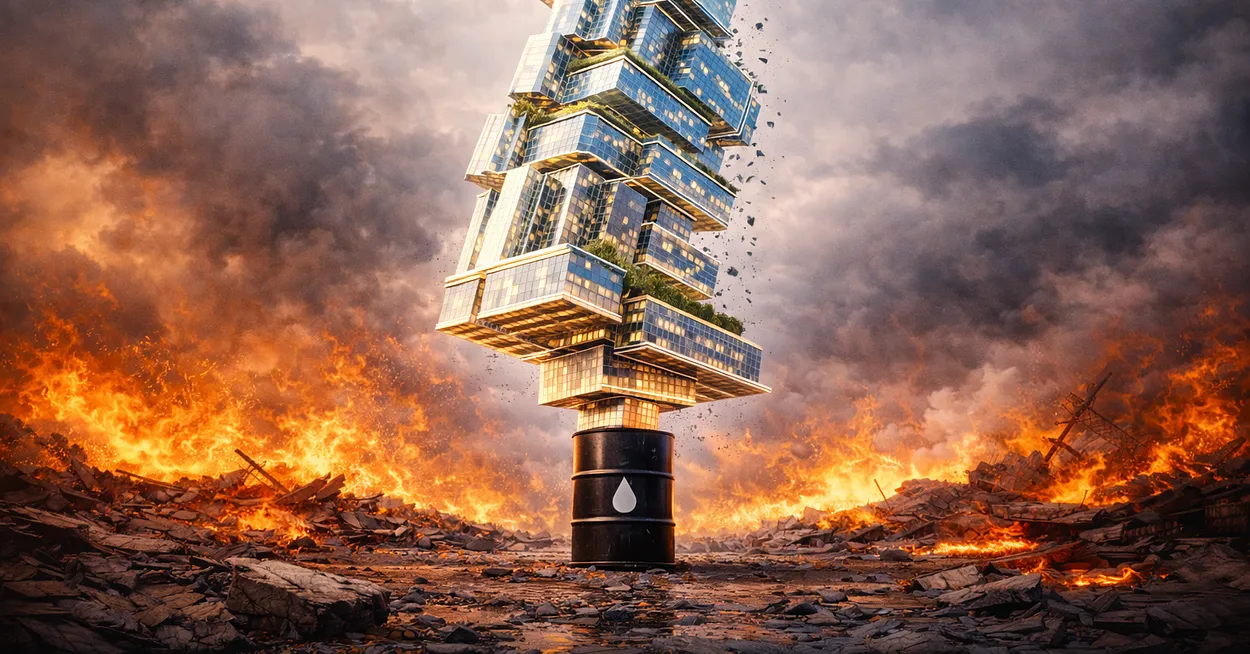
And the basis of that extraction is the extraction of oil. It is the single point of failure for modern civilisation, and Iran just put a ballistic missile onto it.
If these attacks continue, the consequences will unfold with a brutal mechanical logic.
Oil production cannot simply be turned on and off like a household tap. It is a continuous industrial process dependent on pipelines, refineries, tankers, ports, and storage facilities all functioning simultaneously. Destroy enough of that infrastructure and the system jams.
Pipelines fill. Storage tanks reach capacity. Tankers cannot unload. Once storage runs out, wells must be shut down.
Shutting down oil wells is not trivial. Pressure changes can damage reservoirs permanently, equipment corrodes quickly, and some fields never restart properly. Entire oil basins can effectively die from prolonged disruption.
When oil production collapses, everything else follows because oil is not merely a fuel. It is the raw material of modern civilisation.
Plastics, fertilisers, pharmaceuticals, synthetic fabrics, industrial lubricants, electronics manufacturing, packaging, and transport all depend upon petroleum. Remove oil from the system and supply chains fracture almost immediately.
Factories won’t close because they lack labour. They will close because they lack one tiny component manufactured on the other side of the planet. Remove a specialised bearing, a microcontroller, a chemical additive and entire industries stall.
Mining operations halt when replacement parts fail to arrive. Container shipping declines as insurers panic. Air transport contracts sharply as fuel becomes scarce. Construction freezes when heavy machinery cannot be maintained.
Modern industry is not resilient. It is tightly optimised. Optimisation is efficient, but it is also fragile.
No supply lines, no civilisation.
Project the situation forward ten years.
Supermarkets still exist, but their shelves look different. Packaging is simpler and imported foods are rare. Electronics last longer because replacement is difficult. Cars remain on the road far past their intended lifespan.
The smartphone upgrade cycle disappears. Industrial agriculture shrinks as fertiliser production declines. Cities begin quietly contracting as energy-intensive services become expensive luxuries.
The financial architecture of the early twenty-first century fades into memory. Cryptocurrencies vanish. Highly leveraged financial products disappear. Stock markets shrink into something closer to their early twentieth-century form.
And many of the currencies we use today simply cease to exist.
Distance becomes expensive again. Local production becomes necessary again. The globalised consumer civilisation begins to look less like the inevitable future and more like a brief historical experiment.
All this has happened before.
Around 1200 BC the interconnected world of the eastern Mediterranean collapsed. Trade networks stretched from Greece to Egypt to Mesopotamia. Copper came from Cyprus, tin arrived from Central Asia, and grain moved by sea between palace economies that depended upon long-distance logistics.
Then something broke. The climate cycle turned and the structural fragility of the great empires that had ruled for centuries splintered.
The trade networks failed. Cities burned. In some regions writing disappeared for centuries. Historians call this event the Bronze Age Collapse, but the label hides the structural reality.
It was the failure of an interconnected system. When the supply lines stopped, the palaces fell. Social reality had to adjust downward to new logistical realities.
The civilisations of today are recreations of the same state of codependent fragility as the Bronze Age.
Only larger, faster, and far more dependent on energy.
We built a civilisation whose prosperity rests on a handful of fragile global networks, with the most important of them all running through the world’s oil fields.
Place the system’s single point of failure in and around a region dominated by religionists with catastrophic beliefs about the end times, and we won’t have to imagine the outcome.
We’re about to live it.
You can find Dr. David Hilton at Substack.