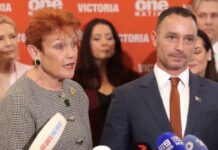

One Nation has responded to popular pressure to harden its immigration policy, unveiling a plan to cut immigration numbers by 750,000 over three years.
ONE NATION TO SLASH IMMIGRATION BY 750,000
One Nation will reset Australia’s immigration system and slash the number of temporary visa holders and unlawful non-citizens in the country by more than 750,000 over three years. The major plan will restore Australian living standards,…
— Pauline Hanson 🇦🇺 (@PaulineHansonOz) September 13, 2026
From Twitter:
One Nation will reset Australia’s immigration system and slash the number of temporary visa holders and unlawful non-citizens in the country by more than 750,000 over three years. The major plan will restore Australian living standards, ease pressure on housing and essential services and bring population growth back to a sustainable rate.
One Nation leader Senator Pauline Hanson said Australians have had enough of mass migration and have been heard loud and clear.
“I know Australians are doing it tough. Families are competing with hundreds of people for rental accommodation. Patients are stuck in ambulances because there are not enough hospital beds. Young Australians are being locked out of home ownership while wages and infrastructure fail to keep up,” Senator Hanson said.
This is good rhetoric, honing in on the key drawbacks of mass immigration. Crucially, the party is attempting to distinguish itself from the uniparty:
“The Labor-Liberal political cartel has sacrificed Australian living standards to serve vested interests demanding continued mass migration. Under Labor, the number of temporary visa holders has surged from 2 million in 2022 to roughly 3 million in 2026.”
The economic literacy is apparent, pointing out that GDP growth on paper is illusory if GDP per capita declines:
“A larger economy on paper means nothing if Australians are poorer per person and cannot afford a home, find a hospital bed or get ahead. A larger economic pie doesn’t mean anything if individual Australians’ slice of it is getting smaller.
Getting into the nuts and bolts of the policy, we can describe it as a good start:
“One Nation’s plan will return the temporary migrant population to around 2017 levels and the international student population to 2015 levels.”
Those levels were still too high. One Nation burst back onto Australia’s political scene in 2016 precisely because Aussies started to notice that immigration levels were already too high.
“Over the three years net overseas migration will be net-negative. Following this, One Nation’s net overseas migration ceiling of 130,000 per year would remain in place.
“We will crack down on illegal migrant employment, cutting off illicit income and encouraging departures. Illegal migrants will be given three-months to leave Australia. Those who depart will be allowed to apply for a visa in the future. Those who remain unlawfully after this period will be subject to immigration enforcement and a lifetime ban from re-entering Australia.
“Tinkering around the edges will not fix the damage. This is about giving Australians breathing space by drastically cutting the stock of temporary migrants, restoring control and making sure migration serves Australia.”
The next paragraph contains one of the greatest lines in the entire press release, followed by one of the most bizarre things I have ever read:
“Vested interests and elite economists will shriek at the prospect of these cuts. (Great, but….) But Canada has shown you can cut migrant numbers, take pressure off rents and still grow the economy.”
What? Canada is almost as screwed demographically as Australia.
From here the good rhetoric returns, pointing out that universities have become visa factories:
“Universities will still be able to enrol more than 100,000 international students per year. Universities that provide accommodation for their international students will get priority for these places. Our new high-value postgraduate study visa will also help attract the world’s brightest minds in science, engineering and medical research, giving Australia the talent we need to compete and returning universities to their proper role as research institutions rather than visa factories.”
Not bad, however the universities must be abolished and their grounds almost entirely flattened, leaving only the historical buildings standing, if it can be helped.
They sneak this in near the end:
“The temporary skilled migration program will remain available and be driven by employer demand. One Nation will maintain the existing seasonal worker programs, such as PALM and the working holiday maker program. Employers will still be able to sponsor skilled migrants, but temporary skilled migration will no longer operate as a sham family migration pathway.”
Those are jobs Aussie teenagers could be doing. Such policies merely suppress wages.
“One Nation’s previously announced policy to pause new migration from countries the Department of Foreign Affairs and Trade rates ‘do not travel’ because of terrorism or other extreme security risks will continue to apply. The use of taxpayer-funded legal aid for visa appeals will also stop.”
If we can “pause”, why not just end it altogether.
“We will take back control of who comes here and how many we accept, train more Australians, restore living standards and put the safety and security of Australians first.”
That Howardesque flourish in the last paragraph strengthens the impression that although a cut of 750,000 migrants is a good start, One Nation is still attempting to juggle competing interests rather than being genuinely committed to securing Australia’s demographics.
Despite the recognition that we cannot tinker around the edges when it comes to immigration, this policy still does precisely that with regard to temporary work visas, universities, and the stated intention to return to a net annual immigration level of 130,000 after three years.
This is why we have to talk about race. The negative consequences of mass immigration are clearly understood and the policies outlined will indeed alleviate the pressure. However, the number one problem with mass immigration is that it is mass replacement immigration.
The Australian people are precisely that, a people, a distinct ethnicity. We are the descendants of the British settlers who built this country in its first century and a half. Since World War 2 our demographics were systematically diluted by other European stock, before pivoting to replacement migration from the rest of the world in recent decades.
A party which is serious about defending the Australian people will articulate this directly, and present a policy to restore Australia’s demographics over the course of a generation.
Several minor parties to the right of One Nation have better immigration policies, including the White Australia Party, whose appeal to the High Court against its ban looks by all accounts to show great promise. Its leader Thomas Sewell stated that should his party be allowed to run, and win seats in the upper house, it would be prepared to work directly with One Nation in order to maintain pressure to harden its immigration policy.
A series of protests across the country, and questions regarding One Nation’s fluctuating fortunes in the polls has also maintained pressure from the right. Pauline will be aware of Restore Britain’s challenge to Reform UK in Great Britain. This press release demonstrates that activism and the presence of parties to the right of One Nation is working.
Thus the key takeaway is, turn up the volume.