When I first started publishing political commentary 10 years ago, I called my blog The Folly of Reason. The banner image I chose was of the beheading of Louis XVI by the National Convention during the French Revolution. What I was trying to communicate back then, and since, is that our modern worldview is flawed because it is based on the faulty foundations of human reason rather than on something metaphysically true. I also believed, and do so now even more, that we are living through a period that will become just as politically violent and chaotically insane as the French Revolution did.
We are now further into the maelstrom, and after ten years of prayer for wisdom and earnest research to try to find a basis for the historical cycles that underpin our social reality, I still maintain the same view. We are headed into a time similar in tone and tenor to the 1770s to the 1790s, and in this three-part series on the modern religion of leftism I will be making the metaphysical case for why that is.
In this first piece, I will be outlining the fundamental mechanism of planetary conjunction cycles that drive historical change over time. After decades of trying to get to the ultimate ‘Why?’ of history, this is it. This is the answer.
In the second piece, I will explain the particular planetary cycles behind the shift from hierarchical religion and landed elites during the ancient and medieval periods toward individualist belief systems and financial elites since the Renaissance. In the third and final piece, I will drill down into the conjunctional cycles at play from 2025 to 2035 that indicate this will be a bloody collapse of civilisation into revolutionary anarchy. There is every reason to expect it will be much more intense than even the previous such period in the late 18th century.
In my book on the theory of the Great Year, I outline the highest level cycle of celestial governance. This theory builds upon the divine council theory popularised by Dr Michael Heiser and well-known to scholars of ancient religion generally and ancient Hebrew religion in particular. The divine council theory states that ancient peoples did not look out at an empty cosmos; they saw the heavens as governed personally by a council of gods under the headship of the king of the gods, culturally understood. For the Greeks, this was Zeus and the Olympians, who had taken over the divine council governance of the cosmos from the Former Gods, Kronos and the Titans. Among the Canaanites, it was Bhaal and his siblings, who had taken over from El. In India, it was the devasabhā of Indra. In China, the celestial court of the Jade Emperor. Among the Aztecs, it was the celestial assembly at Teotihuacan. These small-g gods lived atop temples and cosmic mountains like Olympus and governed the cosmos.
Second Temple period Jews called the small-g gods elohim, as is clear in Psalm 82, Deuteronomy 32, and elsewhere in Scripture. The main difference of the Hebrew religion was that God the Creator is sovereign above the small-g gods He created, and he delegates governance of Creation to this divine council. If you wish to explore this more deeply, I lay out the evidence in my free course,Introduction to Biblical Cosmology.
In summary, the ancients including the Hebrews and Jews looked at the stars and saw the royal court of heaven. The stars were the gods. The only difference for the Hebrews was that those gods were created beings under the sovereignty of the Most High, whom the Hebrews had access to and who was far more powerful than the gods of the nations. That was what their entire religion was all about.
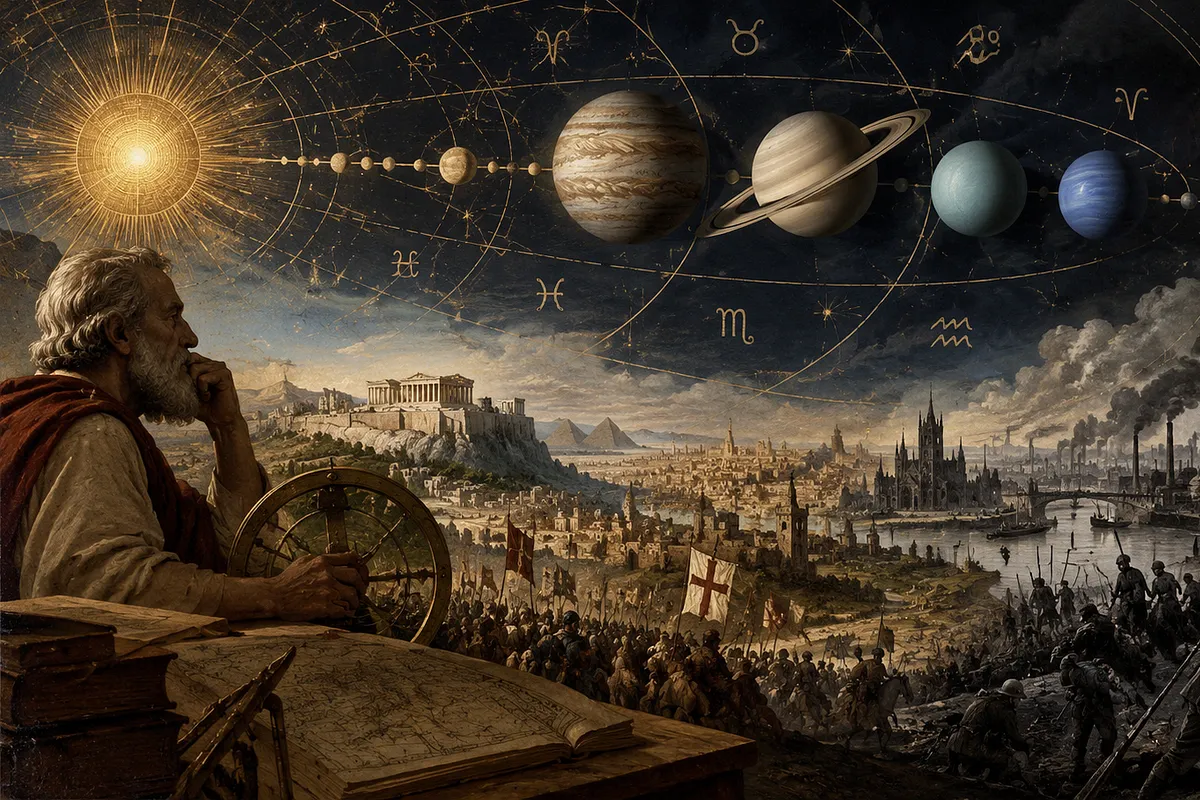
Beneath the highest level of celestial governance by the fixed stars of the zodiac signs of the Great Year are the lower-level cycles of the planets. The word ‘planet’ originates from the Greek planetai, meaning ‘wandering’. They were the stars that didn’t stay fixed but instead moved independently, although still in an orderly fashion. In Plato’s Timaeus, they are understood to mark time. For the Greeks, the planets weren’t naughty or disobedient, but rather closer and more immanent for us humans than the fixed stars. This is where the Hebrew tradition diverged sharply.
In the Hebrew cosmos, the small-g gods were rebellious. The wandering nature of the planets marked them as embodying this motif of celestial rebellion. This carries through into the New Testament, in which Jude (13; ESV) condemns the wandering stars ‘for whom the gloom of darkness has been reserved’. The planets represented disorder in the Hebrew astrological worldview in a way not present among the Greeks or other ‘pagan’ nations. The Enochian tradition among the Hebrews correlated the wandering stars to the rebellious elohim from before the Flood and also the rebellious elohimassigned to the nations at Babel. For Second Temple period Jews, the equivalences were well established. Jupiter was Belial or Satan (Revelation 2:13) and Saturn was Semiyaza, the leader of the Former Gods imprisoned in Tartarus (2 Peter 2:4). This was the cosmos of the early Judean church; a cosmos in which mythology, theology, and astrology were all part of the worldview of God’s people.
Ezekiel saw wheels within wheels in his vision, and it is my contention that this would have been understood by an ancient reader as referring to the cosmic cycles of time. It’s a reference to nested astrological cycles. Can we test this hypothesis then? Are there indeed planetary cycles that govern our collective human experience over time?
In the second piece of this three-part series I will answer this question by applying this framework of planetary conjunctional cycles to the rise of leftism and the shift away from centralised state religion toward individual ideological belief systems since the Renaissance. We will see why leftism has become the dominant political force since the French Revolution, and why the coming decade will see a final spasm of leftist political violence that may well accompany the collapse of modern industrial civilisation itself.
Originally published at Metaphysical History. You can purchase Dr. Hilton’s books here.