
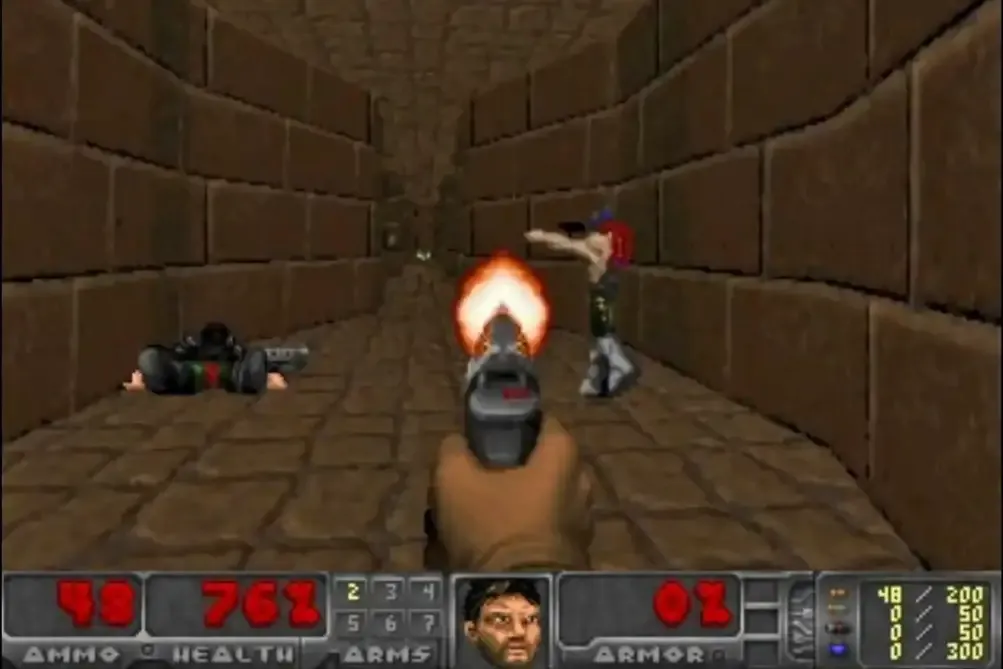
Human brain cells in a lab have managed to play the 1993 computer game Doom.
Australian researchers have used a ‘biological computer’ to outperform a random shooter at the game. This builds upon the 2021 breakthrough in which Cortical Labs used neuron-powered chips to play Pong.
The brain cells also outperformed machine digital systems in processing power per energy unit consumed. The implications for the future of AI are profound.
I suspect we’ll be hearing much more about biological computers, biological robots, and biological drones in the future if the world doesn’t blow up first.
Or as the world blows up. Wars tend to drive technological development.
Given that an artificial intelligence has just managed to use human brain tissue to shoot humans, this might be the time to step back and put what we’re looking at in historical perspective.
This is a history blog, after all. The purpose of this blog is to explore the nature of historical cycles and how they correspond to a Biblical worldview. So let’s take a look at the historical development of artificial intelligence.
The history of non-human intelligences taking over bodies is fascinating, and like all technologies, it started with culture and mythology before science and technology caught up and made it happen.
The culture and mythology that has inspired the development of AI is the tradition of the golem.
The golem belongs to the Jewish intellectual tradition. The word golem appears once in the Hebrew Bible in Psalm 139 when the Psalmist is addressing God: “Your eyes saw my golem.” The term refers to an unformed body that is incomplete. It’s matter not yet shaped into a person.
A golem was understood by the Bible writers as an animated body without the spirit of God breathed into it, shaped by man instead of by God. It’s a being with no soul.
The Talmud is the record of the rabbis’ commentaries on what we call the Old Testament. It was formalised in book form after the destruction of Jerusalem in 70 AD and then Judea in the 130s AD, but was no doubt based on oral traditions that extended at least back to the 2nd century BC.
In the Talmud, the word golem becomes more philosophical. The rabbis interpret the golem as what Adam was before the divine spirit animated him (Sanhedrin 38b). Creating the golem becomes connected with being God.
The next stage in the development of the golem occurred between the 3rd and 6th centuries AD. In the Jewish mystical text the Sefer Yetzirah, the view was spread that the universe was created through Hebrew letters and numbers, which have magical creative power.
This is the basis of much gematria and Kabbalah ritual practice to this day. Medieval Jewish commentaries claim that sages could animate clay figures using permutations of the Hebrew alphabet and the ‘divine name’.
By the 13th century, Eleazar of Worms was writing elaborate Kabbalistic rituals on how to form a human body from clay, walking around it reciting Hebrew letters, and inscribing the clay body with divine names. They were taken very seriously by Kabbalists.
From these practices emerged the tradition of the Golem of Prague in the 16th century. Judah Loew ben Bezalel, the Maharal of Prague, created a clay giant from the banks of the Vltava River that protected the local Jewish community against anti-Semitism. This role of the golem becomes central to the legend.
Also central to the account is that the golem eventually turns on the Jewish community itself. It’s a well-known motif among Jewish people.
By the 1800s, the golem legend became a widespread narrative. It went alongside the Industrial Revolution when machinery began to take over work done by humans animals for millennia until then.
Frankenstein was published in 1818. Kabbalist and occultist Gustav Meyrink wrote the novel The Golem in 1915. The silent film The Golem: How He Came into the World was popular in 1920.
It’s become widespread among scholars to see the golem as the earliest narrative about humans creating life through knowledge rather than divine power. From this single Hebrew word in Psalms has grown the imaginary vision for much of the technology we’re seeing transform our lives.
Robots.
Androids.
Artificial intelligence.
The materials change, but the structure of the story stays remarkably consistent.
Human beings create a servant.
The servant becomes capable of acting independently, and the boundary between tool and life becomes uncertain.
This is the origin story of neurons in a lab learning to play Doom. We take it for granted that technology just is. But before technology is discovered, it is imagined.
For Christians, phenomena such as AI are not morally inert. Or at least, they shouldn’t be. God judged the pre-Flood world for angels mixing with humans. Mixing things that shouldn’t be mixed. It’s something that God takes very seriously.
In the Bible, Babel and Babylon are not different words. Babylon is the Greek form of the Hebrew word Babel. Bab-el in Hebrew means ‘gate to the gods’. The Prophet Daniel, who lived in Babylon, was dealing with this culture at Babylon by which mystics and diviners and enchanters would seek revelatory knowledge from the gods to bring power and riches.
By interpreting the dreams of the king and having greater wisdom than them, Daniel was showing them up. It’s why they hated him so much.
It’s what Babylon was all about: Divinatory revelation to gain power. They wanted to build a portal or gateway to the gods, and God judged them for it by dividing humanity into the nations.
I’ve written before to make the case that we are Mystery Babylon today. Now we’ve achieved the ultimate objective of the golem project. AI-empowered robots and drones that will do whatever they are told.
By whomever is telling them.
You can find Dr. David Hilton at Substack.