This is the second of a three-part series on the cosmic forces behind modern leftism.
We finished in the prior piece with the question of whether there are identifiable, provable planetary cycles that govern history.
Indeed, there are. These are known as conjunctional cycles, and they operate at lower time levels than the multi-millennial Ages of the Great Year. The longer the cycle the higher the level it operates at, and each of these cycles in turn happen in particular zodiacal signs, which then determine their nature.
The longest planetary conjunctional cycle is that of Pluto and Neptune, which has an interval of approximately 493 years. It is the cycle that marks changes in power (Pluto) and belief (Neptune) across the civilisations of the world. And it is why we have modern leftism. Let me explain.
The last full Pluto-Neptune cycle occurred from 1398 to 1892. For the preceding period since 1073 BC, this cycle had been occurring in the sign of Taurus. Taurus represents earthly materialism, stability, and agriculture. We can see evidence of this Taurus phase of the Pluto-Neptune cycle in the pattern of landed aristocracy, fixed social hierarchies, and agriculture as the overwhelming occupation for most humans during the period from the Bronze Age Collapse shortly before 1073 BC to the late 14th century. Life during that period for most people involved agricultural production under the control of aristocratic or monastic landowners.
In 1398 AD, the Pluto-Neptune conjunction occurred for the first time in Gemini. Gemini is a very different beast from Taurus. Gemini is mercantile rather than aristocratic, intellectual rather than materialist, inquisitive rather than acquisitive. Gemini is governed by Mercury, and therefore is by nature mercurial, changeable, and intellectual. It is therefore no surprise that the early 15th century marked the beginning of the transition from a world controlled by landowners and priestly elites to one controlled by bankers and intellectual elites. It was the beginning of what we’ve come to call modernity.
These transitions are not instant. They occur over centuries as conjunctional epochs move from one to the next. There are events which occur at or around the times of the conjunctions, however, that indicate the new direction humanity will be heading in.
In 1388, the Hanseatic merchants left Flanders and were granted trading privileges in Holland, establishing the trend of transregional and later transnational merchant networks expanding international monetary flows. In 1389, Portuguese traders were given trade rights to operate independently also. In 1390, the Nuremberg paper mill is established, paving the way for the printing press later. In the 1390s, vernacular language was established in religion such as Czech-speaking chapels and in culture such as the publication of Chaucer’s Canterbury Tales. In 1402, early Reformation figure Jan Hus took over the Czech-speaking Bethlehem Chapel. In 1403, the writings of Wycliffe became a matter of controversy in Prague. In 1394, the Great Western Schism split the papacy; a pope in Avignon contended against the pope in Rome in a very dualistic, Gemini theme. Universities became centres in which the Schism was debated, inaugurating the role of dialectic and reason in modern governance. In 1397, Manuel Chrysoloras began teaching ancient Greek in Italy and Ptolemy’s Geography was published there by him. It was translated into Latin in 1406. A Florentine Greek-humanist school organised around Chrysoloras there, paving the way for the Renaissance to begin decades later. In 1403, currency markets in Barcelona developed which Cambridge historians have argued was a major step in the process of metallic money becoming abstract via written instruments. Now we have Bitcoin. In 1407, state finances became accounting claims rather than physical treasure held by a sovereign, and in 1408 Genoa authorised written book transfers of payments rather than physical transactions of coin.
Evidence of a transition from an epoch of Taurus to an epoch of Gemini are not only to be found in Europe. In 1392, the famously scholastic Joseon Dynasty was established in Korea. Korea is the birthplace of Gyemija moveable type printing in 1403, 50 years before Gutenberg. In 1404, Gujarat was established in India, a kingdom famous for banking and text-based maritime commerce. Gujarati merchants become dominant in the Indian Ocean at the same time, facilitating the emergence of the Melaka Sultanate in the Malay Peninsula. The power of Delhi, associated with agricultural aristocracy, was broken by the Mongol destruction of the city in 1398. The Turco-Mongol conqueror Tamerlane swept away many of the landed elites of Western Eurasia, paving the way for more mercantile states to emerge after his death.
In the events of this transition we can see the seeds of what later became the travels of Marco Polo, the colonisation of the New World for resources by Europeans and the establishment of global trade routes, the Renaissance, the Reformation, and ultimately our modern world based on philosophical reason, individualism, global commercial networks, and binary divisions in geopolitics, politics, culture, and identity. These are all Gemini themes, and they are such powerful ones because of the way that Ezekiel’s wheels within wheels work. Conjunctions of outer planets determine major historical-epochal trends.
As well as conjunctions themselves, there are also subsequent planetary interactions between the conjunctions known as aspects. They are essentially when the planets make significant angles with each other as they move through the cycle. There are several aspects evident between Pluto and Neptune from 1398 to 1892, however we will now focus on the waning trine of 120° from 1777 to 1785. This is the revolutionary period of the late 18th century, which as we will see in the next piece in this series was a similar time to the period of 2025-2035 we’re about to live through.
The 1770s to the 1790s was the period not only of the American Revolution, but also the French, and it was during the French Revolution that we see the formal beginning of modern leftism. The National Constituent Assembly was established in Paris in 1789, and the most ardent supporters of the revolution against the landed gentry sat to the left of the president. The defenders of monarchy, established religion, and the traditional hierarchy sat to the right. This is the genesis of the modern parliaments we are ruled by today, and the dialectical power binaries we find in every Western-influenced country around the world. The next aspect of the Pluto-Neptune cycle was 1844-1845, and it was in 1844 that Marx and Engels both laid out their philosophical frameworks, met in Paris for the first time, and egged each other on to become less abstract and more concerned with the transformation of material social conditions. This led four years later to the publication of The Communist Manifesto.
Since the French Revolution, it has been the left that has operated as the force of abolition, rebellion, and revolution in the name of progress. The conservative right forms in reaction. We are still stuck in this paradigm.
This is the epoch of ideology, and there is no astrological reason to think that it will end any time soon, barring a higher-level cataclysm triggered by the end of the Age. Leftism has only become more powerful since the 1892 conjunction, from which time we’ve seen the rise of modern socialism, communism, fascism, and the plethora of forms of ideological utopianism seen around the world since the early 20th century.
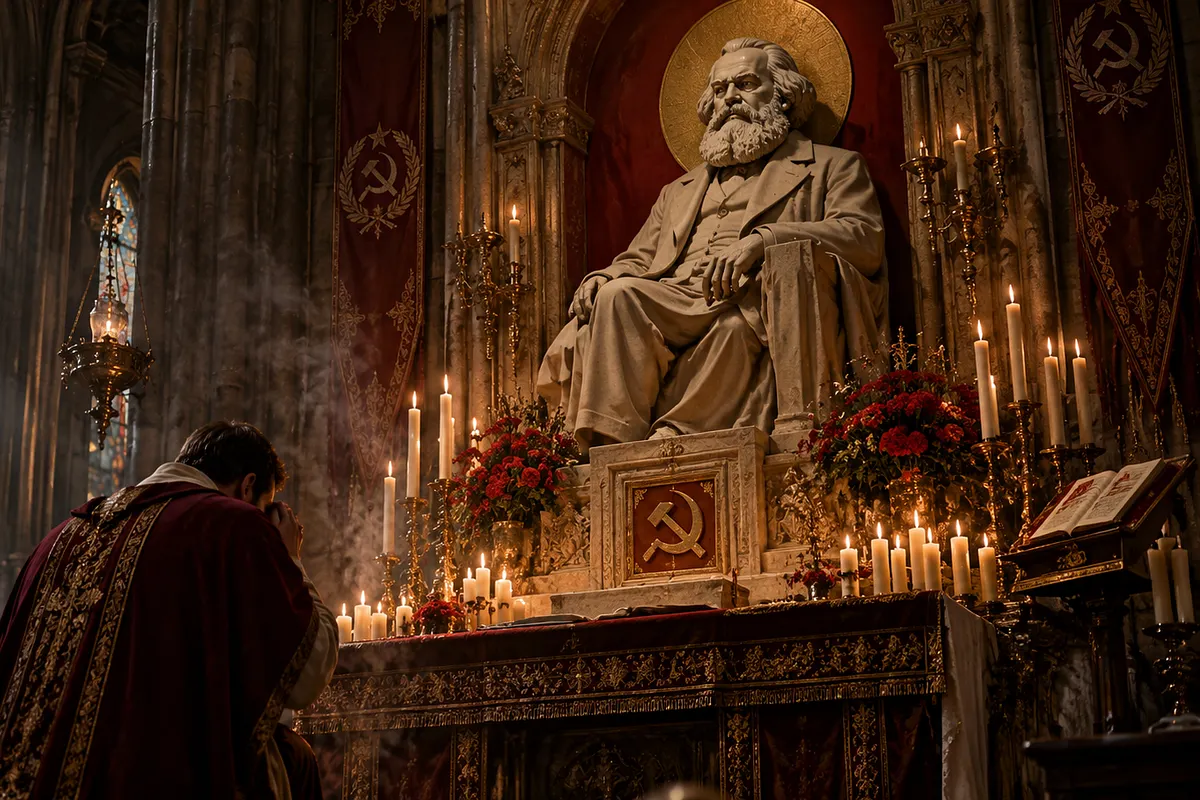
Ideologies are concerned with power and how it should be held and distributed, but their origin is in religion. The aspects of the Pluto-Neptune cycle that were concerned with freedom of thought and expression against church dogmatism in the 14th and 15th centuries became concerned later with the development of modern leftism. Leftism, therefore, is understood as a continuation of religion stripped of its explicit metaphysical focus. Ideological leftism inhabits the part of the human mind that was once concerned with religious belief. Ideologies are religions, for all intents and purposes. They provide the interpretive and moral framework for the individual to operate within society.
Where the pious medieval peasant woman looked out on a world full of sin and debauchery needing the cleansing of holy repentance, the self-righteous postmodern girlboss looks out on a society full of male oppression and marginalised identity groups needing the cleansing force of cancel culture and diversity festivals. It’s the same psychology in a different epoch. The second is also more mercurial in that is not as stable and realistic. It has no anchor in reality.
The Pluto-Neptune conjunctional cycle has become relevant for us today, as it has entered its first 60° waxing sextile phase this year and will be in this aspect until 2032. The historical pattern for these first aspects since each conjunction is that these are periods in which the paradigm first seeded at the conjunction itself become established and operational. The last conjunction occurred in 1891-2, around which time we saw: the establishment of the first socialist political parties such as the Australian Labor Party after the Second International; female suffrage extended; the Sherman Antitrust legislation passed in the US; land reform movements get going with the spread of Georgism and awareness of how appropriation of land leads to unjust collection of the economic rent; the first explicitly Marxist party arises in the German SPD; public control and ownership of assets become a mainstream topic; the Social Gospel movement getting going with Francis Bellamy writing the Pledge of Allegiance in exactly 1892; and Irish Home Rule beginning.
The focus on land reform is especially interesting given its relation to the long-term transition from millennia of conjunctions in Taurus into the epoch of conjunctions in Gemini. Land and ownership are becoming intense political issues in Australia again, and we could expect that during this first aspect of the cycle that reforms around land ownership and subsequent inequality will become established. The age of the landlord is over, we should expect.
The next ten years contain another element to do with Pluto that will make this period particularly intense. It’s a pattern that we haven’t seen since the 1790s. We will be discussing this pattern, and why it may herald the collapse of governments around the world, in the final piece in this series.
Originally published at Metaphysical History. You can purchase Dr. Hilton’s books here.