
My great-grandmother could spend an entire day washing clothes.
Not tidying them. Washing them.
Water had to be hauled and heated. Shirts were scrubbed against boards until the fabric surrendered its dirt. Each garment had to be wrung by hand, the water twisted out through sheer effort, and then carried outside and hung to dry.
It was ordinary work. No one thought of it as exercise. But it was exercise.
What appears mundane to us required hours of sustained physical effort. The entire rhythm of daily life demanded movement, lifting, carrying, scrubbing, walking. Bodies were not trained in gyms because they were trained by life itself.
Then the machines arrived.
The Industrial Revolution did more than reorganise production. It quietly reorganised the human body.
Tasks that once demanded strength were mechanised. Transport replaced walking. Household appliances removed the physical demands of domestic labour. The washing machine alone erased one of the most exhausting recurring tasks in ordinary life.
Convenience accumulated, and with it came a subtle shift in the baseline expectations of the human body.
One striking indicator is grip strength. Physiologists often use it as a simple proxy for overall physical robustness. Across multiple studies, male grip strength has declined noticeably since the nineteenth century. The human body, it turns out, adapts to the environment it inhabits.
Remove the need for effort, and the capacity for effort begins to fade.
The body is efficient in this way. It keeps what it needs, and discards what it does not.
This pattern, however, is not new.
The ancient Mediterranean world experienced a softer version of the same transition. As cities expanded and wealthy households relied increasingly on enslaved labour, the elites of Greece and later Rome found themselves strangely removed from the physical demands that had once defined ordinary life.
Agrarian societies produce strong bodies almost by accident. Urban wealth, by contrast, tends to outsource labour.
The response was cultural rather than technological.
The Greeks developed the institution of the gymnasium, a place where citizens deliberately trained the body through exercise, wrestling, and athletics. The Romans later embedded similar practices within the social life of the baths.
What had once been unavoidable labour became structured activity, and exercise became a scheduled activity useful for networking purposes.
The pattern is evident in both the ancient and modern examples. When labour disappears from ordinary life, societies invent artificial substitutes to push back against entropy.
Modern gyms operate on precisely the same logic.
The treadmill simulates walking. The rowing machine simulates rowing. Weight machines replicate the lifting that once occurred in farms, docks, workshops, and building sites.
We have built elaborate rooms full of machines designed to imitate the physical work machines eliminated. Exercise is no longer something that simply happens. It is something we book between meetings.
The irony is difficult to miss. We solved the problem of toilsome physical labour and now we work soul-destroying jobs to earn debt credits to buy back the opportunity to do toilsome physical labour.
Behind this pattern lies a simple rule about human abilities. They persist when they are required, they decay when they are no longer required.
We see the same dynamic in smaller things. The arrival of digital storage weakened the everyday habit of memorisation. Navigation skills decline when every journey is guided by GPS. Mechanical knowledge fades in societies where devices arrive sealed, specialised, and impossible to repair.
The human mind is remarkably adaptable. It conserves effort wherever possible.
Which brings us to a new and more subtle substitution.
Our great-grandfathers built the houses their children grew up in. Most postmodern bugmen can barely assemble a flatpack.
Ancient thinkers occasionally worried about this sort of development. When writing began to spread across the Greek world, some suspected it might weaken the mind.
In the dialogue Phaedrus, Plato recounts a story in which the invention of writing is criticised for encouraging people to rely on external symbols rather than on internal memory. Instead of remembering knowledge, they would merely consult it.
He was probably right, although we can’t prove it. Ancient wandering poets memorised entire books to recite to audiences.
While books preserve knowledge across centuries and enable the continuous development of civilisation, they may have done so at the cost of our individual cognitive abilities. Digitisation has supercharged that process.
Whether the digitisation of our civilisational knowledge has made civilisation more fragile is something we’ll have to find out about. The burning of a single library at Alexandria 1500 years ago destroyed enormous amounts of accumulated knowledge. What happens when ballistic missiles take out data centres and the libraries had digitised all the books?
Artificial Intelligence introduces a different kind of substitution. While writing stored thought, AI produces it. Or at least, mimics the simulation of it. Is that still thinking?
Tasks that once required sustained intellectual effort, the drafting of text, summarising research, analysing information, even constructing arguments, can now be automated with remarkable speed.
In the Soviet Union, workers joked that they pretended to work while the bosses pretended to pay them. In the postmodern West, students pretend to write assignments and teachers pretend to mark them.
The machines of the nineteenth century replaced muscle. The machines of the twenty-first are replacing cognition.
As our muscles were replaced, we decayed. We had to invent social practices to compensate, but we’ve never fully gained back the physical fitness we once had.
And now the same technological processes that did that to our bodies have made a quantum leap in doing that to our minds.
Thinking itself will thin. Attention spans are already shortening. We’re drugging kids, especially boys, to make them pay attention. Deep reading is becoming an elite pastime. Our abilities to reason will follow.
It’s like the old shampoo ad. It won’t happen overnight, but it will happen.
It will mean that the human capital required to run complex civilisation, already under threat from demographic shifts, may well become insufficient to keep the lights on. The only strategy at that point would be to hand over control of civilisation itself to AI.
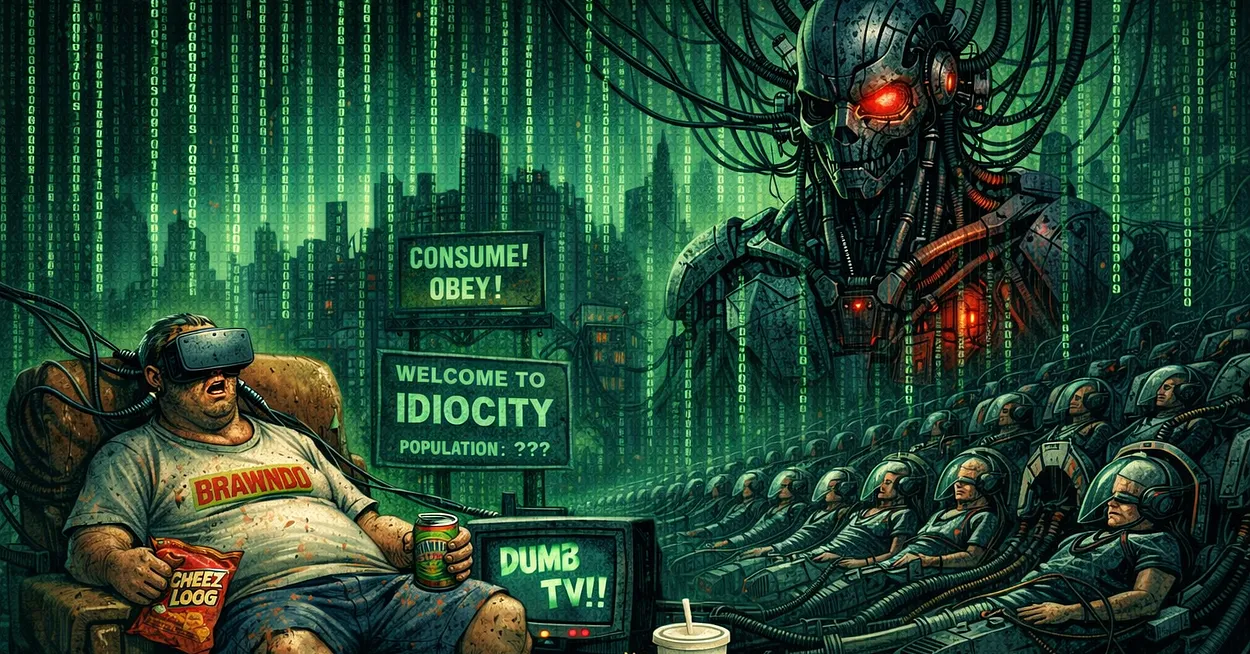
Will high-agency individuals and communities develop habits of intentional cognitive exercise via rigorous reading and arduous study to compensate, or will we slide into idiocracy ruled over by a matrix that we can’t even maintain anymore?
The normies are trying to give their kids an edge by getting them to code. Maybe that’s smart. I’m not sure though that AI won’t be doing the coding.
Maybe they should give their kids books.
You can find Dr. David Hilton at Substack.