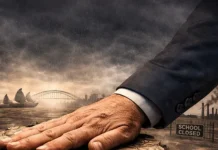
PM Albanese this week did one of the only two things Australian politicians know how to do in response to a crisis. He announced a subsidy.
Given that he’d already set up a ‘task force’ committee, this was the only card he had left to play. He fearlessly declared that the government will change export-finance laws so that oil importers can get subsidies from the taxpayer to delay the inevitable moment of reckoning from Iran’s strategy of squeezing America’s vassals by the cajones via oil.
Not only was it brave. It was also stunning.
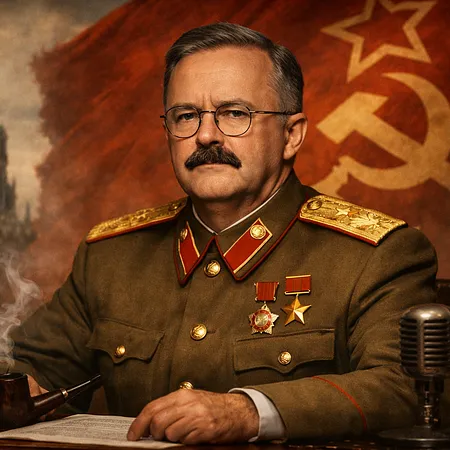
The phrase “Potemkin village” comes from the old Russian story that Prince Potemkin built fake villages to impress Catherine the Great as she travelled through newly conquered territory. Whether the original story is fully true is almost beside the point. It survived because it names something real. A Potemkin village is a facade. A front. Something built to look solid from a distance while hiding how little is really there underneath. Which is why the image fits Russian political culture so well, all the way through to the Soviet world of propaganda, parades, heroic posters and films like Battleship Potemkin. The point was not just power. The point was to make power look convincing when reality fell short.
A country the size of Australia should not be scrambling for an extra few weeks of diesel.
Australia is not Singapore. It is not Malta. It is not some cramped little import-dependent city-state with no room, no resources and no strategic depth. It is a continent. It is rich in energy, rich in raw materials, and built around vast internal distances that only function because liquid fuel makes those distances traversible.
And yet, not long ago, Anthony Albanese was effectively forced to ease diesel quality rules because the country needed a little more breathing room.
That should have been treated as a national embarrassment. Instead, it was treated as heroic government by the establishment media.
That is the part worth noticing. Not just the diesel issue itself, but the way it was absorbed into the normal rhythm of Australian politics, as though this is simply what leadership looks like now. A policy setting quietly creates fragility. The fragility starts becoming inconvenient. The government adjusts the setting slightly. The media reports this as calm crisis management. As Churchillian. Then the news cycle moves on.
But if you stop and look at it properly, it tells you something important.
Diesel is not some obscure technical issue. It is not one more line item in a policy briefing folder. It is what moves the country. It runs the trucks. It runs the farms. It runs the machinery that sits behind the machinery. In a place like Australia, diesel is not optional. It is one of the things that turns geography from a liability into the basis of our way of life.
Which is why this sort of thing matters.
If a country like Australia is suddenly discovering that fuel policy has consequences, then the problem is not really fuel policy. The problem is that the people running the country no longer seem to think in material terms. They think in administrative, moral, media, and symbolic terms. But not in the older, harder language of industrial reality.
That is the thing modern politicians seem least able to understand. A civilisation does not continue because it has the correct values statement. It continues because the physical systems underneath it continue to work. Our civilisation continues in its current form because fuel and spare parts arrive, freight moves, food can still be produced, transported, and sold, and distance can still be overcome at scale.
Australia, more than most countries, depends on that.
We are not a compact little European state with rail lines, density and inherited redundancy built into the landscape. We are a very large place held together by movement. Remove enough movement, or make it sufficiently unreliable, and what begins to break down is not just commerce but societal coherence.
That is why the whole diesel episode was so revealing. It showed, very briefly, that the people in charge do not really govern the Australia that exists. They govern a kind of administrative fiction layered over the top of it. An Australia of targets, frameworks, optics and announcements. An Australia where reality is something to be narrated, not secured.
That works for a while. It’s worked for them for quite a long time, given that we have spent the last few decades moving through a historical period of relative stability and American imperial economic expansion after the crisis of World War II and the detente of the Cold War. As American power stretched across the globe and the American imperial ideology is based on (a predatory and usurious form of) free trade, the political class in Australia became less and less leaders and more and more administrators. Everything was optics, my fellow working Australian battler.
Albanese’s fuel announcements this week were less the actions of a serious state than the improvisations of a political class that still thinks governance means explaining away consequences after they arrive. That is the pathology of modern Australian leadership. These people were not formed by scarcity, risk or hard constraint. They were formed by faction rooms, media cycles and the sort of undergraduate debating society culture that mistakes verbal fluency for competence. So when reality finally intrudes in the form of diesel, reserves, shipping and strategic vulnerability, they do what they have always done. Reframe, reassure, and hope nobody notices that the adults never really turned up.
That, in the end, is what a Potemkin politician really is. Not simply a liar, and not even simply a coward, though there is usually enough of both. A Potemkin politician is something more specific. He is a man produced by a fake world and perfectly adapted to surviving inside it. He knows how to look official, how to sound measured, how to gesture toward responsibility while standing in front of hollowed-out systems he neither built nor understands. He is not there to preserve the underlying reality. He is there to maintain confidence in the facade for as long as possible.
And Australia is now full of them.
We are ruled over by people whose entire formation took place in an era where almost nothing truly hard was allowed to touch them. No real scarcity. No real strategic terror. No genuine confrontation with the fact that civilisations are made of physical things that can fail. They have lived inside a padded historical chamber where every problem could be turned into a media event, a values statement, a task force, a subsidy, a slogan, or a ministerial reshuffle. That is why they still behave like undergraduate debating club apparatchiks even while sitting at the controls of a vulnerable industrial society. They think words are steering mechanisms. They think optics are ballast. They think reality can be indefinitely managed by tone.
But reality is not interested in tone.
It does not care how compassionate, progressive, moderate, inclusive or technically compliant a government sounds while it quietly weakens the foundations beneath the country. It does not care how many committees are formed or how many media hits are done or how many little rhetorical sandbags are piled around the latest failure.
If the diesel does not arrive, the diesel does not arrive. If the reserves are thin, the reserves are thin. If a nation has spent decades hollowing out its own resilience while pretending this was moral advancement, then eventually the bill arrives and there is nobody left to hide behind except the same thin, theatrical men who created the problem.
That is the real danger now. Not just Albanese, not just Labor, not just one fuel scare, one shipping disruption, or one panicked week in the market. The deeper problem is that Australia is entering a harder world with a ruling class trained entirely for a softer one. A world of constraints, shocks, shortages, pressure points and consequences is beginning to return, and we are being led into it by people whose highest skill is still explaining why none of this is really their fault.
Potemkin politicians can survive almost anything except the moment the facade stops being load-bearing. They can survive scandal, mockery, bad polling and televised embarrassment because all of that still belongs to the same artificial world that produced them.
But they cannot survive a system that begins to fail in ways that cannot be narrated away. Because at that point the question is no longer what they say, but what still works. And that is where the illusion collapses. Not all at once, not dramatically, but in small, accumulating failures that reveal, piece by piece, that the people in charge were never really in charge at all.
You can find Dr. David Hilton at Substack.