Last weekend I took the family to Sydney for a karate tournament.
It is the sort of thing that we wouldn’t have thought of as an event a decade ago. Load the car, fill the tank, drive a few hours down the motorway, spend the day quoting Cobra Kai one-liners, head home again.
But along the way, something unsettling hit me.
This was beginning to feel already like a bit of a luxury thing to do.
The petrol alone made that clear. What once felt like a routine weekend outing now carries the faint sense of indulgence. A long drive for a hobby. A casual trip between cities. The assumption that fuel will always be cheap enough, abundant enough, and available enough to make such things ordinary.
For most of our lives, we have taken that assumption for granted. Petroleum and its derivatives are the blood of modern civilisation. We take it for granted that its circulation will always supply our needs.
But civilisation is held together by logistics that most people never see.
The supermarket shelves appear full as if by magic. Aircraft cross continents overnight. Container ships arrive in Australian ports stacked high with goods from every corner of the planet. Petrol stations glow under bright lights along the motorway, dispensing energy with the casual ease of a vending machine.
Behind that apparent simplicity lies an enormous machinery of pipelines, tankers, refineries, ports, shipping insurance markets, naval patrols, and financial clearing systems.
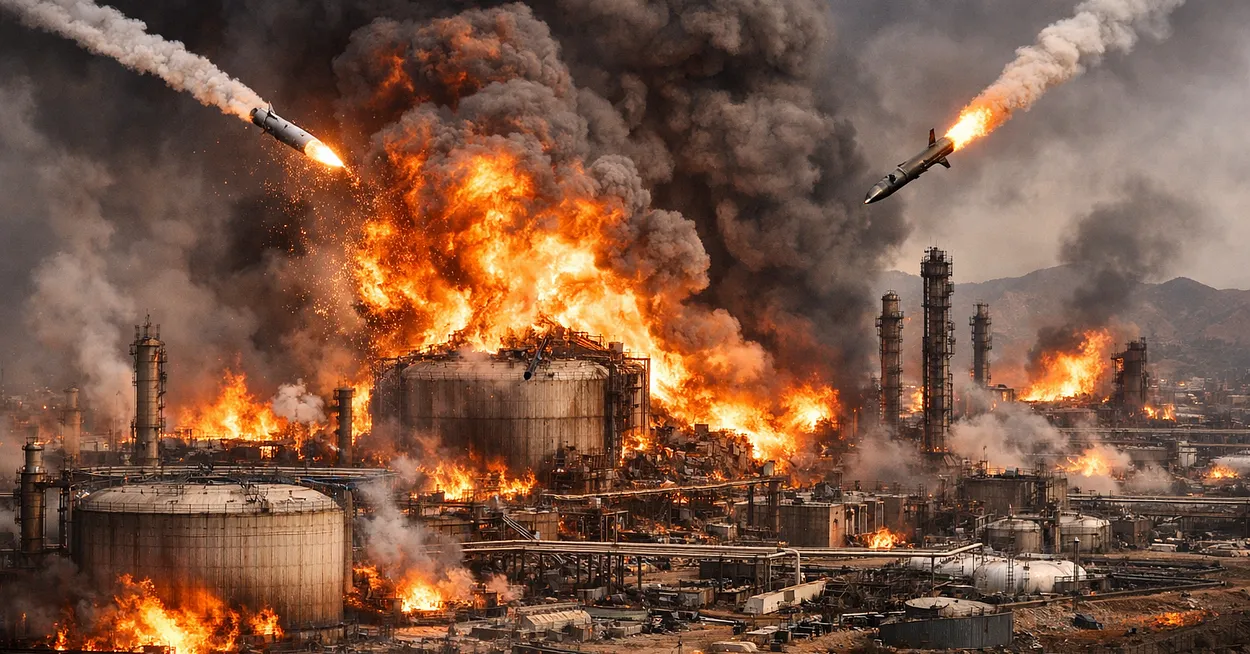
Modern life rests on that machinery, and the heart of that machinery is being exploded as you read this.
It’s a civilisational heart attack, and we get a front row seat to live through it.
The Strait of Hormuz is one of the narrowest and most important arteries in the global economy. Roughly a fifth of the world’s traded oil passes through that thin stretch of water between Iran and the Arabian Peninsula. Tankers leaving the Persian Gulf must navigate a corridor only a few dozen miles wide before entering the wider Indian Ocean.
It’s the narrowest artery in the most vital area of the global circulatory system. Now Iran is blocking it off.
By attacking the oil infrastructure of the Gulf Cooperation Council states and effectively shutting down traffic through Hormuz, Tehran has not merely launched a regional military operation. It has struck directly at the logistical foundation of the modern economic system.
Oil is often described as fuel for cars. That description is convenient but misleading.
Oil is far more than a transportation fuel. It is the industrial blood of modern civilisation.
Petrochemicals form the basis of plastics, synthetic fibres, pharmaceuticals, bitumen, and countless industrial materials. Aviation depends on refined petroleum products. Global shipping runs on bunker fuel. Fertiliser production relies heavily on hydrocarbons. Manufacturing, construction, and modern agriculture all draw deeply from the same energy well.
The plastic case on your phone. The insulation on electrical wires. The paint on your walls. The foam in your mattress. The polyester in your clothes. The tyres on your car. The paint on your car. The seats in your car. The dashboard in your car. The bitumen under your car.
The syringes in hospitals. The packaging around sterile equipment. The fertilisers that grow modern crops. The pesticides that protect them. The shampoo in your shower. The nylon in sportswear. The resins in wind turbine blades. All of these things begin in petrochemical plants.
We do not merely burn oil. We build our civilisation out of it. Remove oil from the system, and the consequences extend far beyond the price of petrol.
Industrial societies function because they possess vast reservoirs of concentrated energy. Oil provides that energy in a form that is dense, portable, and easily stored. It is the quiet enabler of almost everything that makes modern life possible.
But energy alone is not the whole story.
The global oil market is also the hidden pillar of the international financial system.
Since the collapse of the Bretton Woods monetary order in the early 1970s, the United States has effectively anchored the world economy around the pricing of oil in US dollars. Nations require dollars to purchase energy, and therefore hold dollar reserves. Those reserves flow back into American financial markets, reinforcing the dollar’s position as the central currency of global trade.
Energy and finance thus became intertwined.
Oil stabilised the dollar. The dollar stabilised the trading system.
The result was a monetary architecture that supported the enormous expansion of globalisation over the past half-century. Supply chains stretched across continents. Manufacturing dispersed across oceans. Consumer societies in the West imported goods from everywhere while exporting the currency used to purchase them.
Yet this entire arrangement rests on something older that I wrote about in 2024: control of the sea lanes.
For roughly five hundred years, the global trading system has been underwritten by Western naval power. The Portuguese opened the ocean routes in the fifteenth century. The Dutch and the British turned those routes into commercial highways. In the twentieth century, the United States Navy inherited the task of keeping the oceans open.
Global capitalism was never simply a matter of markets and finance. It was also a matter of security.
Merchants will ship goods across oceans only if they believe those goods will arrive safely. That belief depends on naval patrols, international law, and an intricate web of maritime insurance markets centred historically in London.
Trade, in other words, requires both protection and trust. For centuries, the Western maritime powers provided both.
The Persian Gulf oil trade is one of the most important pieces of that structure. Tankers move through Hormuz under the assumption that the sea lanes will remain open and insurable. Shipping firms calculate risk accordingly. Insurance companies price policies based on the expectation that major naval powers will prevent sustained disruption.
But those assumptions begin to unravel the moment a chokepoint becomes a battlefield.
Insurance premiums spike. Shipping companies hesitate. Naval escorts become necessary. Even if tankers can technically pass through the strait, the cost of doing so may become prohibitive.
The system has a myocardial infarction.
Since World War II at least, the Western world has lived inside the illusion that global integration is permanent. Goods flow effortlessly across oceans. Supply chains stretch thousands of kilometres without serious interruption. Distance itself seems to have been conquered.
Cheap energy and secure sea lanes created that illusion.
Yet history offers a more sobering perspective. Large trade networks have collapsed before. The Bronze Age trading system disintegrated around 1200 BC. The Roman Mediterranean fractured in late antiquity. The Silk Road periodically vanished for centuries when political and military conditions made long-distance commerce too dangerous.
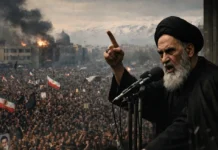
Arrogant neocon think tank intellectuals in America told us we had reached the End of History in the 1990s with the fall of the Soviet Union. The ‘mad mullahs’ say otherwise, and are now bringing history back with a Shahed drone bang.
Iran’s attacks on Gulf oil infrastructure and its effective closure of Hormuz represent more than a regional escalation. They mark a signal event in the slow unravelling of the economic order that has shaped the modern world.
The consequences will not appear overnight. Civilisational systems rarely collapse in a single dramatic moment. Instead, they begin to strain. Prices rise. Supply chains falter. Governments scramble to stabilise markets that were once taken for granted.
Gradually, the underlying assumptions of everyday life begin to change.
A long drive to Sydney becomes something you think about before filling the tank.
For the past half century, the industrial world has lived within a system built on cheap energy, secure sea lanes, and a financial architecture tied closely to the global oil trade. That system produced extraordinary prosperity, but it also created an illusion of permanence.
Now the foundations are beginning to crack.
Modern civilisation likes to imagine that its problems are primarily political or technological. Yet the deeper structures of history are often logistical. Empires rise when they master the movement of energy and goods across distance. They falter when those flows become uncertain.
The tankers burning in the Persian Gulf are therefore more than images of regional conflict.
They’re a planetary blood clot blocking the most important coronal artery of our civilisation.
You can find Dr. David Hilton at Substack.