
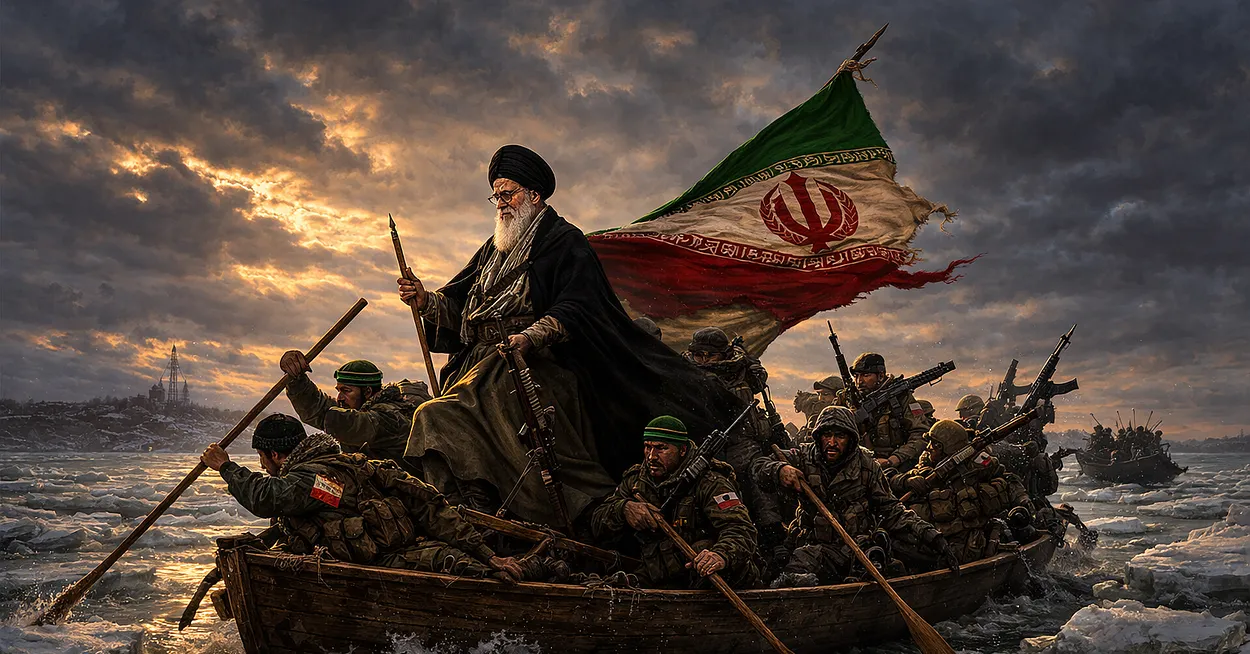
Petrol prices in our area jumped 25% this week. Locals were grumbling about it tonight at the bowls club when we went for tea. When that figure is 500% and groceries are rationed and a military draft has been announced to defend freedom or whatever, the war will be lost. Trump will be Jimmy Carter without the grandfatherly cardigans at that point.
Napoleon Bonaparte is credited with the adage that an army marches on its stomach.
As with most famous facts of history, it’s probably wrong. It may have been Frederick the Great who said it. Probably every great general throughout history has said it at some point or another.
There are many factors to military success. Bravery and general hardiness matter. Technology matters. Religious and ideological beliefs matter. The last thing you want is your soldiers to start wondering if the gods or God or the mandate of heaven is held by the guys they’re trying to kill rather than by themselves.

All of those things matter. Yet beneath all of them, what has ultimately determined the success or failure of a military campaign has been something far more boring and prosaic.
Logistics. Supply lines. Getting your soldiers and their stuff into the theatre of operations, keeping them supplied, and building out the infrastructure necessary to do so. That’s how you win a war, all other things being equal.
It’s largely why invading armies have so often failed once they’re far away from established supply lines and familiar territory. When the Japanese invaded Korea during the Imjin War of 1592-98, they looked unstoppable. Wherever they went, they dealt carnage and destruction. Yet they failed, because the Koreans were able to leverage their turtle ships to cut off the Japanese supply lines and, with Chinese help, defeat the Japanese at sea.
No supply lines, no conquest. That’s the golden rule of invading people.
The British soldiers stationed in North America in the late 1700s would likely not have considered themselves far from home. They were among their fellow Englishmen, after all. Yet once a local colonial elite had gained enough cohesion to challenge the crown, and Washington, the largest landowner in North America, became the unifying figurehead for a new colonial identity, it was just a matter of time before the newly-minted Americans expelled their British brethren.
It is easy today to forget that the US military grew out of a guerrilla insurgency. The colonists constantly attacked the supply routes and storehouses the British relied upon, and the 5,000 km voyage from Britain to replenish men and equipment meant the empire bled out. Like the Romans in Parthia, Napoleon in Spain, and everyone in Afghanistan, the British discovered that distance itself is the inhuman enemy when the human enemies are guerrillas.
Empires can project extraordinary power. They can move armies across oceans, deploy fleets, and build bases on the far side of the world. Yet the further that power travels from its centre, the more fragile it becomes. Every mile adds friction. Every ship, warehouse, road, and depot becomes another point of failure.
Locals resisting a foreign invader know this automatically. Imperial soldiers, far from home, acting on orders, just end up wanting to get out of there.
Invaders usually win the battles but still end up losing the war. Atrocities expand as the strain grows. Local resistance hardens, especially when you’re the Great Satan.
Morale collapses, political will back home dries up, and the empire retreats. This is the process that has now begun to begin in the Middle East.
No amount of American wonder tech will change that calculus, either. Space Force could teleport into Teheran with reverse-engineered UFOs and detonate a gravity wave and America will still lose this war.
An empire is not just a powerful military. It is a logistical system. America’s power depends on a vast network of bases, satellites, shipping lanes, radar stations, intelligence hubs, and energy infrastructure that stretches across the globe.
None of this infrastructure exists in isolation. Each piece depends on the others. Oil flows through shipping lanes. Ships depend on surveillance. Surveillance depends on satellites and data centres. Military bases depend on fuel, supply aircraft, and secure communications.
It is a web, and Iran has spent the last twenty years studying how to tear holes in it.
Iran does not need to defeat the United States in a conventional war. That would be suicidal. Instead, it has adopted the strategy that weaker powers have used against stronger ones for centuries.
Attack the logistics.
Oil facilities are sabotaged. Shipping lanes are harassed. Pipelines are threatened. Regional bases are struck by drones and missiles. Radar systems are probed. Data networks are infiltrated. Proxy militias attack infrastructure across several countries at once.
Each individual strike looks small.
But that is the point.
The American revolutionaries did not defeat Britain with a single decisive blow. They won by forcing Britain to defend everything, everywhere, all at once. Every convoy needed protection. Every port needed soldiers. Every mile of coastline required surveillance.
The cost multiplied.
Iran’s strategy works the same way. Each disruption forces the United States to deploy more ships, more aircraft, more intelligence resources, and more defensive systems just to maintain the status quo. Especially when the Little Satan is getting pummelled by hypersonics, too.
The logistical burden grows heavier every week.
Trump is all-in. Yet eventually every empire that faces this quagmire quandary will ask the same question: Is this worth it?
This is how decadent, hubristic, indebted empires end. Not with a dramatic battlefield defeat, but with a quiet recognition that the outer territories require more energy than they return.
Britain did not lose America because the colonists were stronger.
Britain lost America because the logistics of empire finally stopped making sense. Now the American empire is about to lose the Middle East, and maybe thereby the world.
You can find Dr. David Hilton at Substack.